Roof terms in Mesa, AZ trip up almost every homeowner the first time a contractor rattles off words like "square," "flashing," or "RCV" during an estimate. This glossary breaks down the exact vocabulary Mesa roofers, inspectors, and insurance adjusters use, grouped by category so you can find an answer fast. Learn these terms once and you won't feel talked over at your own kitchen table again.
Quick Reference: Most Critical Roofing Terms by Category
The roofing terms in this glossary fall into seven groups: structure, materials, waterproofing, ventilation, installation, problems, and cost/insurance. Before a bid, the roof terms Mesa, AZ homeowners need most are square, pitch, flashing, underlayment, decking, and ACV/RCV. Learn these six and most estimates start making sense immediately.
- Structure: deck, rafters, ridge, eave, fascia, soffit
- Materials: asphalt shingles, concrete tile, TPO, metal, foam
- Waterproofing: flashing, underlayment, drip edge
- Ventilation: ridge vent, soffit vent, attic insulation
- Installation: tear-off, re-roofing, permit
- Problems: dead valley, dry rot, monsoon damage
- Cost/insurance: scope of work, ACV, RCV
Irish Roofing Company has walked Mesa homeowners through these same terms on inspections and insurance claims since 2019, and this guide was built from the questions we hear most often in the field, not a textbook. For a closer look at how these terms apply to your own home, browse our roofing contractor services or visit the homepage to see our full service area.
Roof Anatomy & Structure Terms
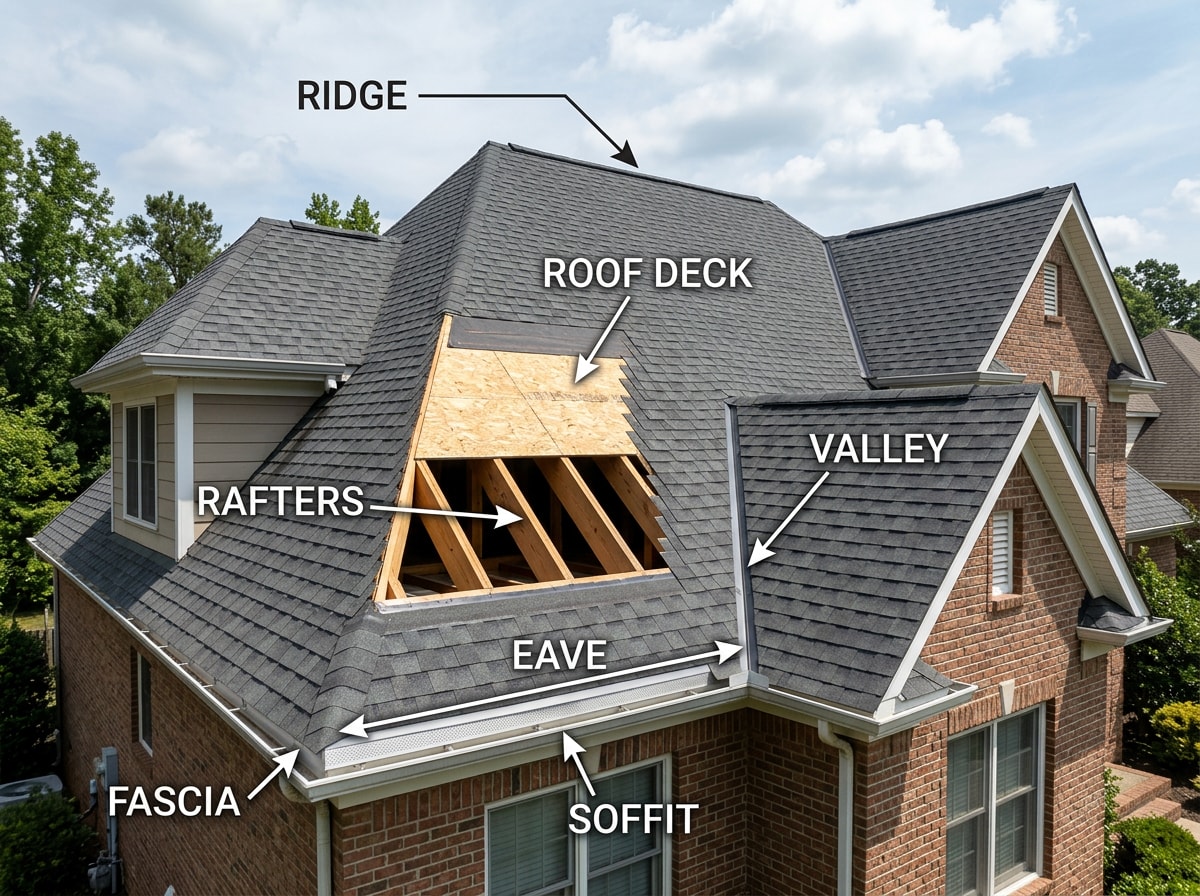
Every other term in this glossary builds on the physical parts of a roof. The roof deck (or decking) is the wood layer fastened to the rafters or trusses. It's the base everything else attaches to.
The ridge is the horizontal peak where two slopes meet. The eave is the lower edge that overhangs the walls.
The fascia is the vertical board capping the eave. The soffit is the underside panel beneath it, often vented for airflow.
A roof valley forms where two slopes meet at an angle, directing water downward. On many Mesa tile roofs, valley detailing is where leaks most often start if flashing wasn't installed correctly. Dormers, rakes, and trusses round out the rest of the structural vocabulary you'll hear during an inspection.
Want to see these parts on your own roof? Our roof inspection service walks through what inspectors check first.
Roof Shape and Measurement Terms
A roofing square equals 100 square feet of roof surface. Roof pitch (or slope) measures steepness as a ratio of rise to run, so a 6:12 pitch rises 6 inches for every 12 inches of horizontal run.
Roofs are generally classified as low-slope or steep-slope, and that classification determines which materials are even eligible for use. The National Roofing Contractors Association defines low-slope roof systems as those installed on slopes of 3:12 (14 degrees) or less, and steep-slope systems as those installed on slopes greater than 3:12 , a distinction detailed in NRCA's technical guidance. This matters in Mesa because flat and low-slope sections, common on additions and patios, require membrane systems like TPO or foam rather than shingles.
Roofing Materials Terms
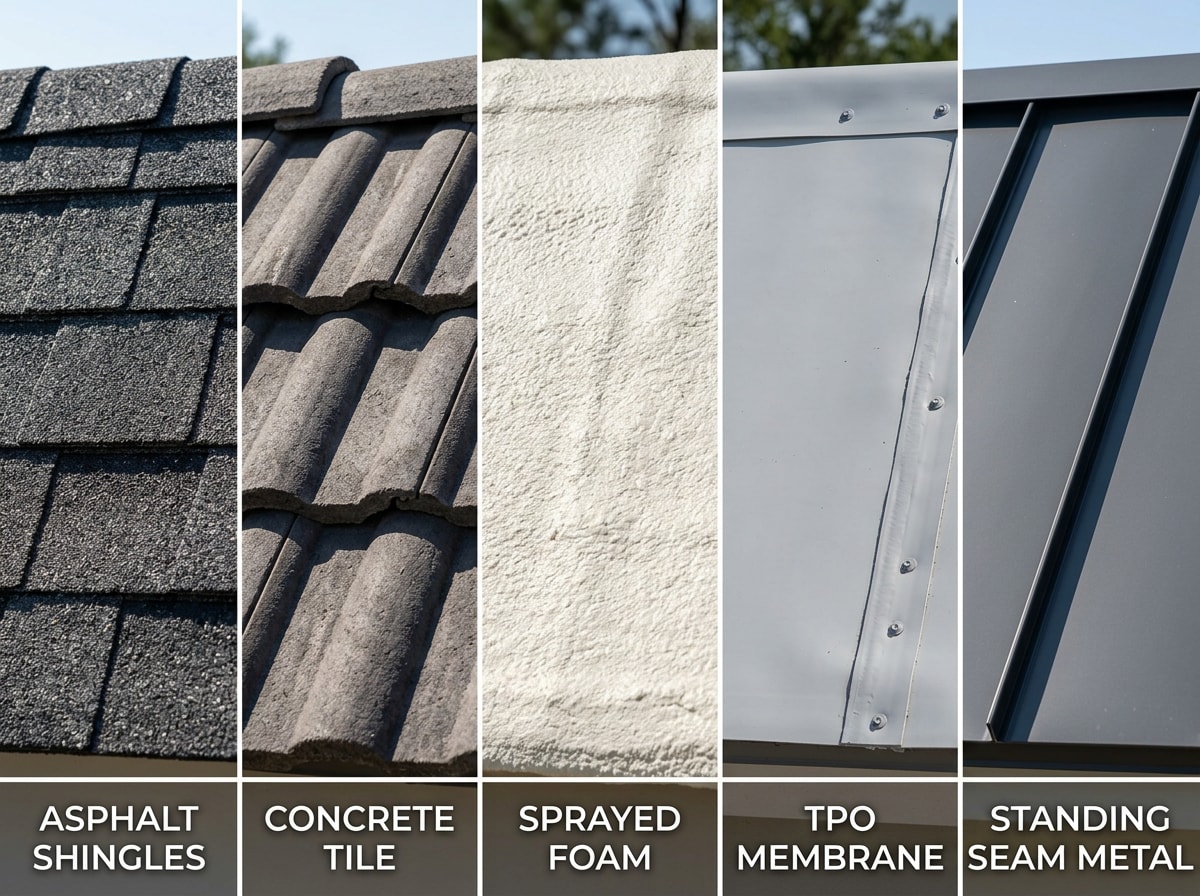
Material choice in the East Valley is driven almost entirely by heat and UV exposure, so this part of the glossary gets the most attention. Asphalt shingles remain the most common residential covering nationally, though sustained triple-digit surface temperatures shorten their lifespan compared to milder climates.
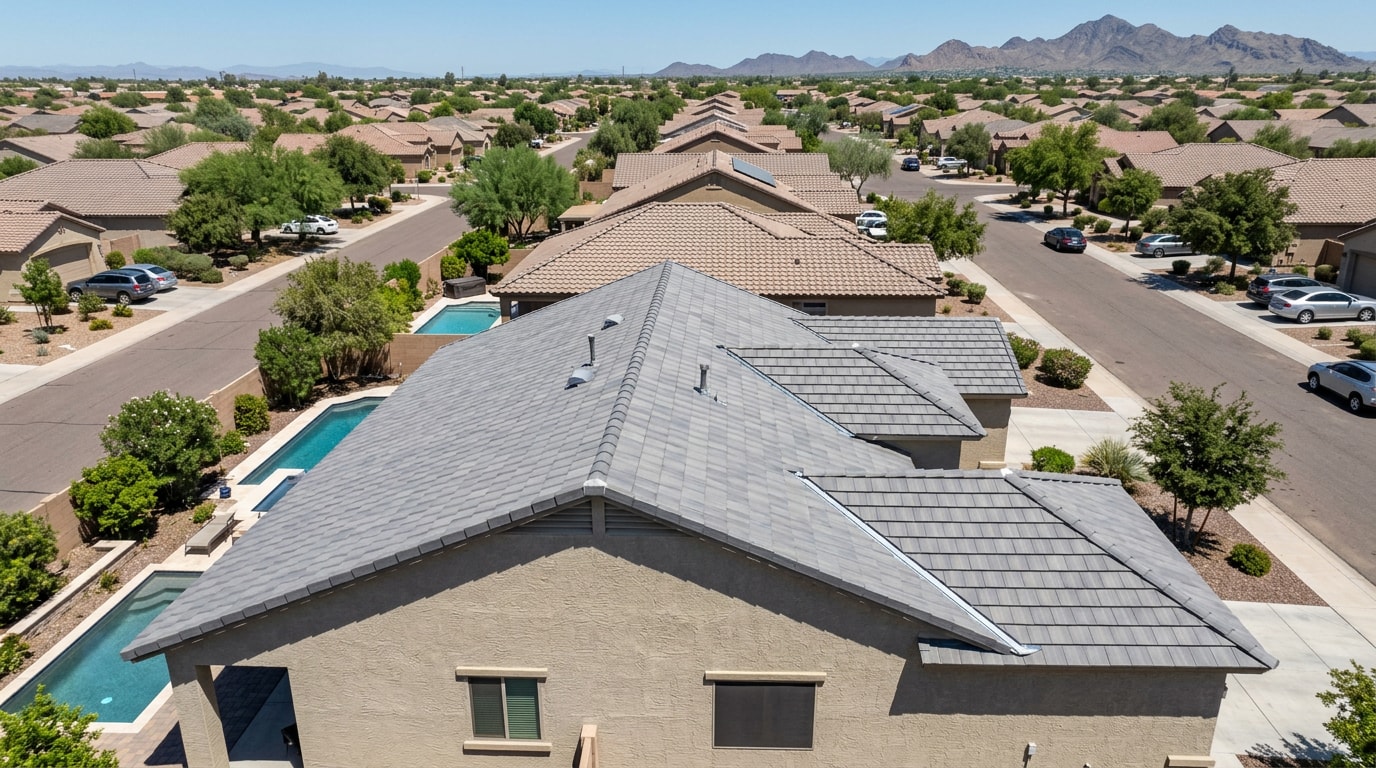
Concrete tile roofing is popular across Arizona because the tile itself sheds heat and resists UV degradation better than many alternatives, even though the underlying waterproofing still needs periodic attention. Metal roofing reflects solar heat effectively and holds up well in monsoon wind.
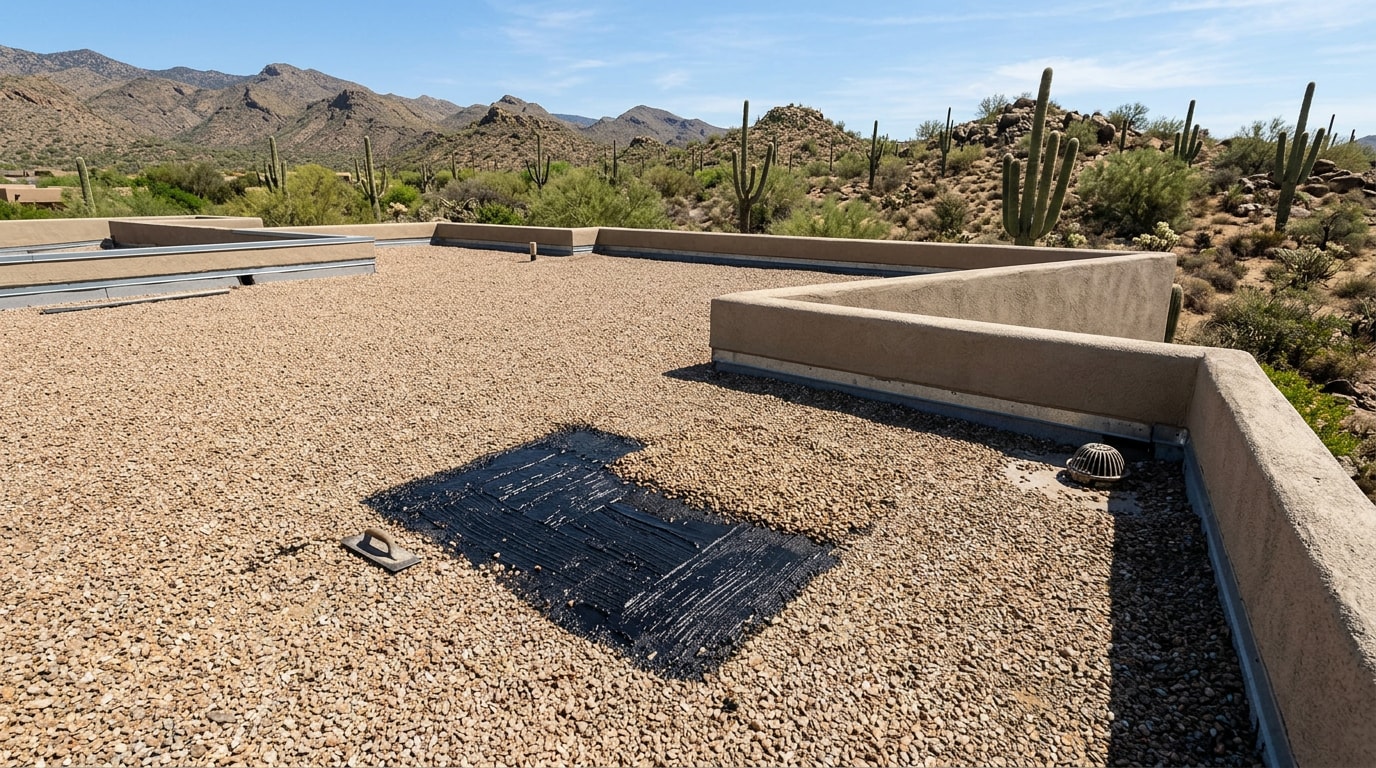
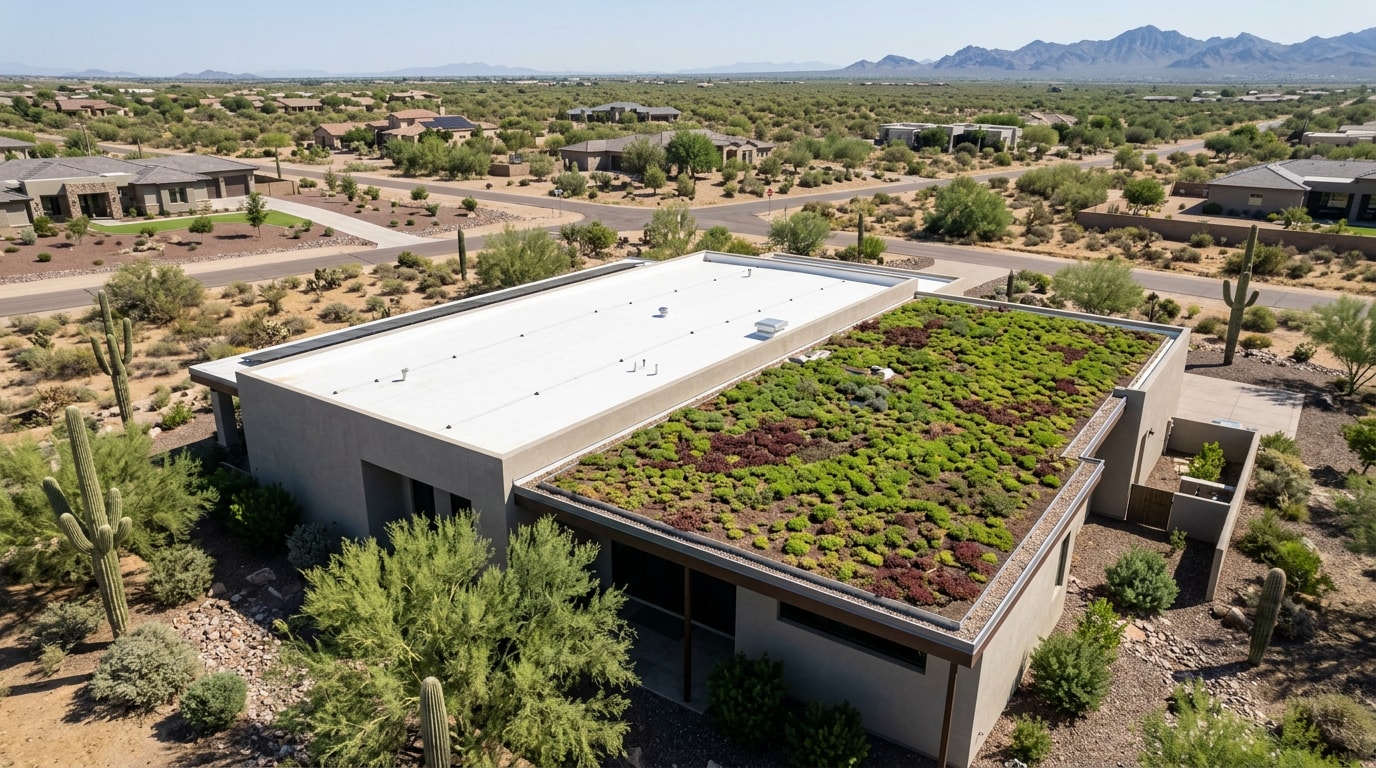
Foam roofing (sprayed polyurethane foam, or SPF) is widely used on low-slope and flat sections for its seamless, insulating surface. TPO roofing, a single-ply membrane, is another low-slope option valued for reflectivity and ease of repair. For reflective roofing performance standards, the U.S. Department of Energy's Federal Energy Management Program maintains cool roof purchasing guidance worth reviewing before choosing a light-colored or reflective product.
Covering types compared
Lifespan and performance vary enough between materials that a side-by-side view helps more than definitions alone.
| Material | Typical Lifespan | Heat/UV Performance | Monsoon Wind Resistance | Relative Cost |
|---|---|---|---|---|
| Asphalt shingle | 15–20 yrs (AZ sun shortens this) | Moderate | Moderate | $ |
| Concrete tile | 40–50 yrs | Excellent | Excellent (if properly fastened) | $$$ |
| Foam (SPF) | 20–25 yrs with recoating | Excellent (reflective) | Good | $$ |
| TPO | 20–25 yrs | Good to excellent | Good | $$ |
| Metal | 40–60 yrs | Excellent | Excellent | $$$ |
Lifespan figures are general ranges and vary by installation quality, color, and maintenance. Not sure which material fits your roof? Schedule a Free Inspection and we'll walk the roof with you in person before you commit to anything.
Waterproofing and Flashing Terms
Roof flashing is thin metal or composite material installed at joints, edges, and penetrations to block water intrusion. It's arguably the single most failure-prone component on any roof. Underlayment is the water-resistant layer installed between the deck and the final roof covering. Even in a dry climate like Mesa's, synthetic underlayment protects against wind-driven monsoon rain.
Drip edge is the metal strip along eaves and rakes that directs water away from the fascia. Building codes require flashing at every roof-to-wall intersection, valley, and penetration. The International Code Council's residential code spells out exactly where flashing is required and how it must be installed, including minimum metal thickness and step-flashing details.
Flashing failures most commonly show up around chimneys, sidewalls, and valleys, exactly the spots local roofers flag after monsoon season. If you're noticing staining near any of these areas, see our flashing and flat-roof repair guide for Mesa or our leak repair services page for next steps.
Flashing by location: a quick map
- Chimney flashing — metal formed around the chimney base to seal that intersection; see our chimney flashing service for repair details
- Valley flashing — lines the valley where two roof slopes meet
- Step flashing — small overlapping pieces along a sidewall, stacked with each shingle course
- Pipe boot — a rubber or metal collar sealing around vent pipes
- Drip edge — see our drip edge page for how it protects fascia boards
Ventilation, Insulation, and Moisture Terms
Attic airflow terminology matters more in Mesa than in most of the country, simply because attic temperatures routinely climb well past outdoor air temperature during summer afternoons. Roof ventilation moves hot, moist air out of the attic space, typically through a ridge vent at the peak paired with soffit vents along the eaves that pull in fresh air. Our attic venting service covers both.
Attic insulation, measured by R-value, slows heat transfer between the attic and living space below. See our attic insulation page for recommended levels in the East Valley.
Inadequate ventilation traps heat against the underside of the roof deck, which accelerates shingle aging and can void some manufacturer warranties in high-UV, high-heat climates. Balanced intake and exhaust venting is one of the simplest ways to extend roof lifespan here.
Installation & Repair
Tear-off means removing the old roofing material down to the deck before installing new material. This is standard practice for most Mesa reroofs since layering over old shingles traps heat. Re-roofing sometimes refers to installing new material over an existing layer, where code allows it, though tear-off is generally preferred for tile and heat-sensitive materials. Our re-roof page explains when each approach applies.
Any reroof project in Maricopa County needs a permit and inspection sign-off, and code compliance terms will appear throughout your contract. Deck attachment, fastening patterns, and underlayment type are all inspected items. See our roof replacement service page for what a typical installation timeline looks like.
Roofing Problems
A dead valley is a low-pitch area where two roof slopes converge with almost no slope left to drain water, creating a pooling point that's especially prone to failure under monsoon downpours. Dry rot refers to decayed, weakened roof decking, often caused by long-term moisture intrusion that went unnoticed under flashing or shingles.
Monsoon roof damage covers wind-lifted shingles, driven-rain intrusion, and debris impact from Mesa's summer storm season. Months of intense heat baking materials brittle, followed by sudden high-wind monsoon cells, is a uniquely Arizona failure pattern. Materials that would hold up fine in milder climates can crack or lift here from thermal cycling alone. If any of these terms show up on your inspection report, our roof repair team can help you prioritize next steps.
Cost and Contractor Terms
A roofing permit is the municipal approval required before work begins. Scope of work is the itemized document describing exactly what a contractor will do, down to materials and fastening specs. A roofing estimate is a non-binding price projection, while a roofing contract is the signed, binding agreement. Don't confuse the two when comparing bids.
Insurance money terms at a glance
ACV (Actual Cash Value) pays the depreciated value of your roof at the time of loss, while RCV (Replacement Cost Value) pays what it actually costs to replace it today. The gap between the two is often thousands of dollars. According to the Insurance Information Institute, a replacement cost policy pays the full cost of installing a new roof, while an actual cash value policy pays only a smaller percentage of the cost of replacing it . Many policies pay ACV first and release the depreciation (RCV minus ACV) only after repairs are completed; see the Insurance Information Institute's claims explainer for the full breakdown.
Say this, not that: safe storm-claim language
When documenting monsoon damage for an adjuster, avoid guessing at causes or ages.
- Instead of "this is from the last storm," say "I noticed this damage after the recent storm."
- Instead of "the whole roof needs replacing," say "here's the visible damage, I'd like a professional assessment."
Precise, factual language protects your claim.
How to Use These Terms in a Real Project
Picture a line on an estimate reading "28 squares, 6:12 pitch, synthetic underlayment, step flashing at sidewalls, RCV basis." With this glossary, that line translates instantly: roof size, steepness, water barrier type, flashing location, and payout structure. Reading an estimate this way makes it far easier to spot missing details before signing anything.
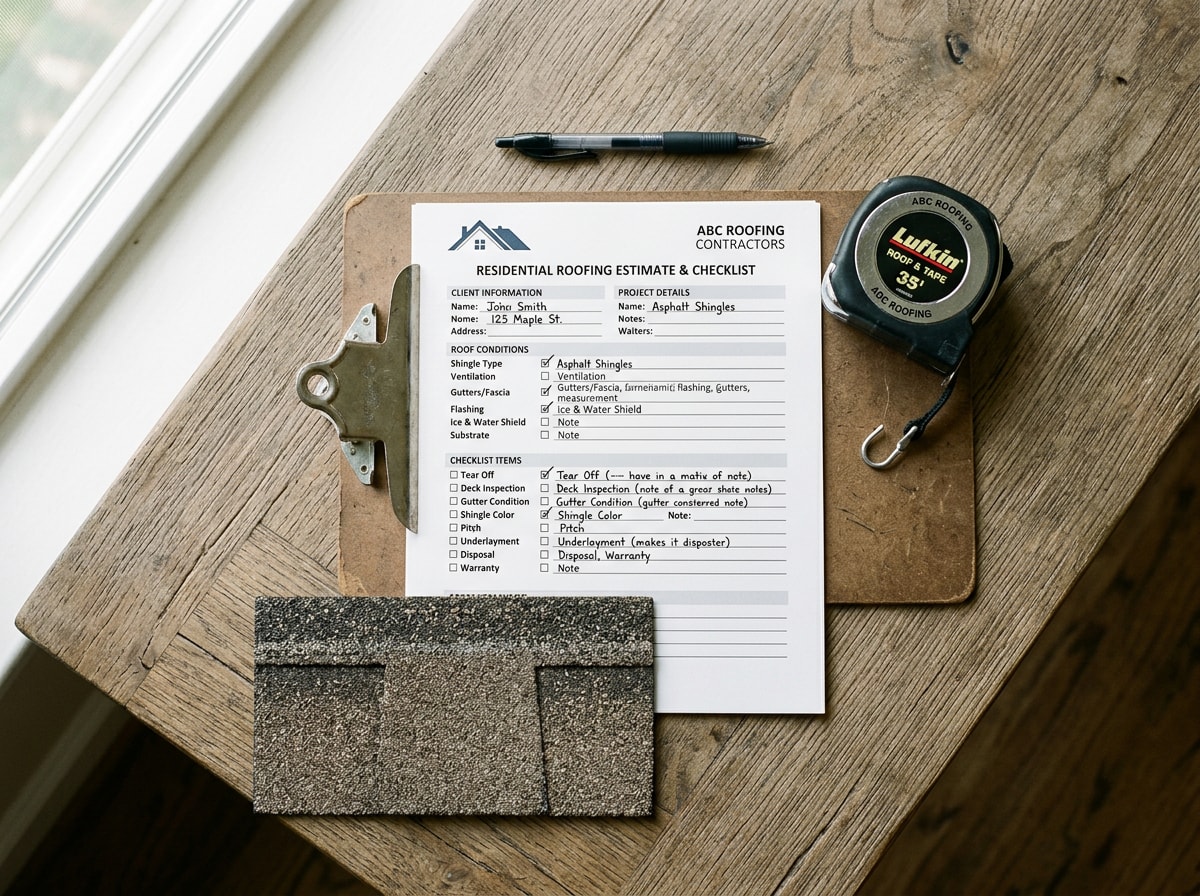
A copy-ready checklist for reading any roofing estimate
- Confirm the total square count matches your roof's actual size
- Verify the pitch/slope is noted correctly
- Check the exact material spec (brand, type, color)
- Confirm underlayment type is listed
- Verify permit costs are included, not added later
- Clarify whether pricing is ACV or RCV
- Review warranty length and what it covers
Ready to see how these terms apply to your own roof? Schedule a Free Inspection with our Mesa, AZ crew, or browse recent projects in your neighborhood.
FAQ
What is the difference between roof pitch and roof slope?
Roof pitch and roof slope both describe steepness, but pitch is traditionally expressed as rise over a 12-inch run (like 6:12), while slope can be expressed as a percentage or rise-over-span ratio. In everyday use, most Mesa roofers use the two terms interchangeably.
What roofing terms should a homeowner learn before signing an estimate?
Before signing, learn square, pitch, flashing, underlayment, decking, and ACV/RCV. These six terms appear on nearly every estimate and cover size, slope, waterproofing, and insurance payout structure, the areas where misunderstandings cause the most frustration later.
Why do roofers use squares instead of square feet?
Roofers use squares because material such as shingles, underlayment, and membrane is manufactured and priced in 100-square-foot bundles. Measuring in squares keeps ordering and labor estimates consistent across different roof sizes.
What are some common slang terms used in roofing?
Trade slang includes "dry-in" (getting underlayment installed before rain), "cap" (ridge cap shingles), and "tear-off" (stripping old roofing before replacement). These informal terms often show up in verbal conversations even when the written estimate uses formal language.
What roofing terms should every homeowner know?
The highest-priority terms are square, pitch, flashing, underlayment, and ACV/RCV. Knowing these five lets you follow almost any roofing conversation in Mesa, from the initial inspection through final insurance paperwork.
What does "scope of work" mean on a roofing contract?
Scope of work is the itemized list of exactly what the contractor will do: tear-off or overlay, materials and brand, fastening pattern, flashing locations, underlayment type, and cleanup. If a bid doesn't spell this out, ask for it in writing before you sign.