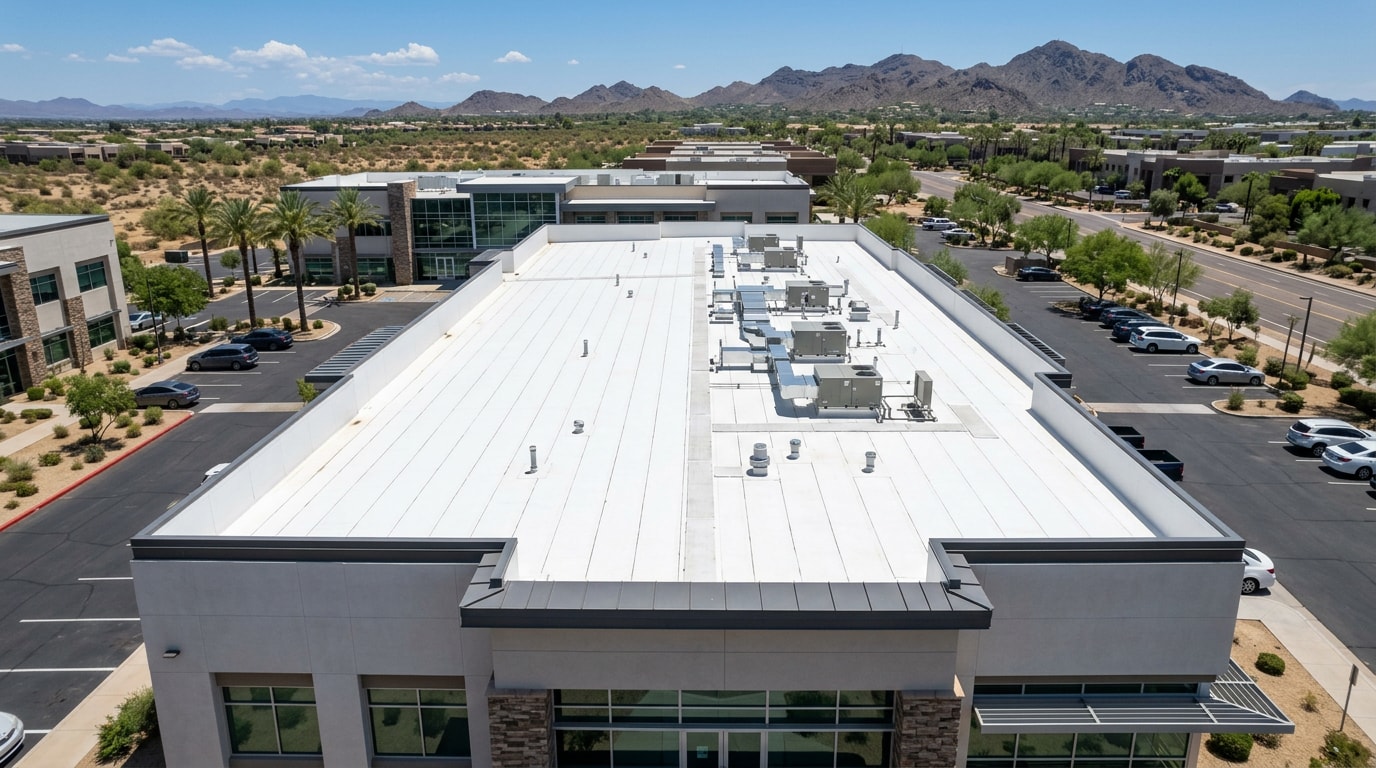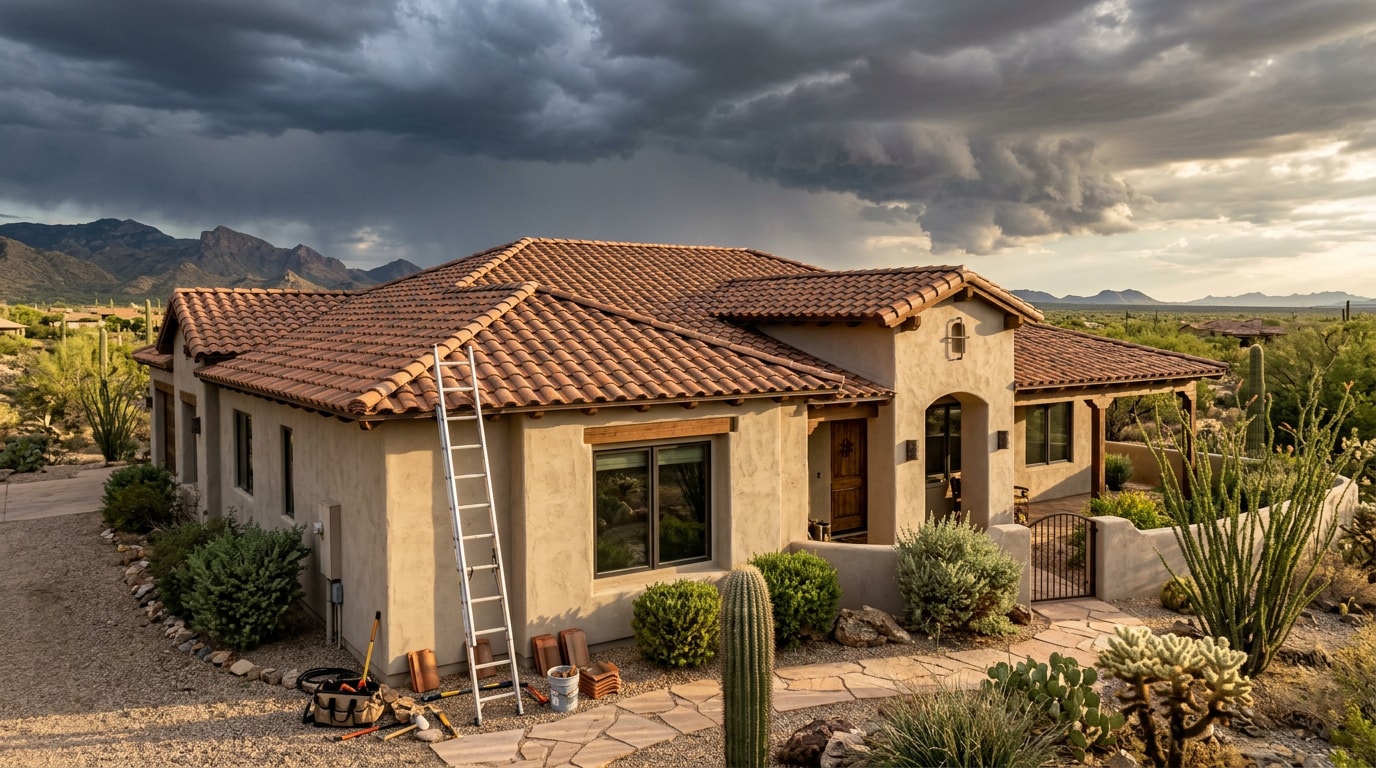
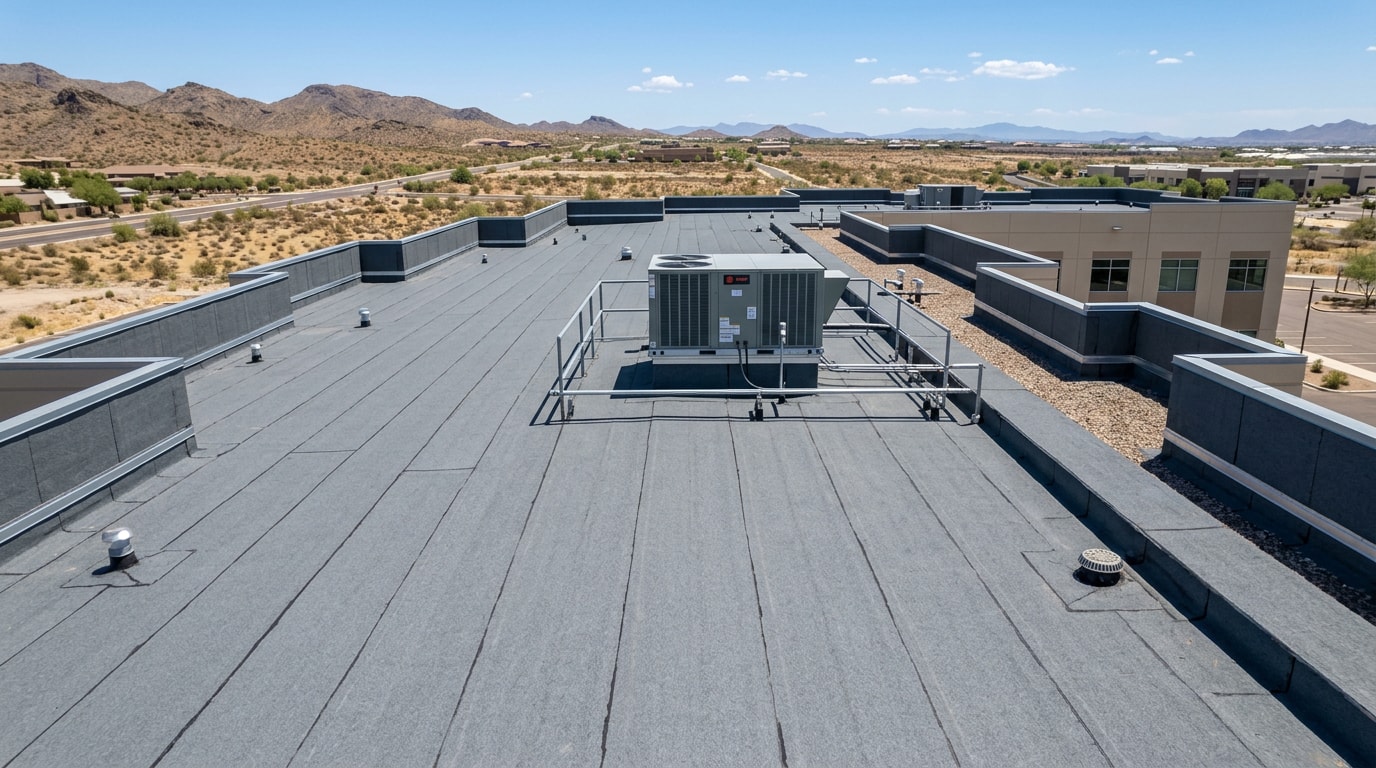
Modified bitumen roofing is one of the most common flat-roof systems installed on Queen Creek homes and businesses, from covered patios to commercial strip centers along Ellsworth Road. This guide covers real 2026 costs, how long it lasts under Arizona's sun, and what separates a mod-bit roof that hits 20 years from one that fails at 10.
Reviewed by John McClean, owner and ROC-licensed roofing contractor (AZ ROC #325437) at Irish Roofing Company, who has spent two decades installing and repairing flat roofs across the Phoenix Valley.
What Is Modified Bitumen Roofing?
Modified bitumen, often shortened to mod bit, is a rolled asphalt membrane reinforced with polymers for flexibility and weather resistance. A modified bitumen roof is an asphalt-based membrane modified with SBS or APP polymers to add flexibility and durability .
Two polymer types dominate the market:
- SBS (styrene-butadiene-styrene) — a rubber-based modifier known for cold flexibility.
- APP (atactic polypropylene) — a plastic-based modifier that handles sustained heat well, which is why installers lean on it throughout the Southwest.
For hot, sunny climates, APP is the better-performing modifier because its higher softening point means the membrane is less vulnerable to heat-induced stress, and the UV resistance means the cap sheet holds up through years of intense sun without accelerated degradation . That tracks with what our crews see on patio covers and commercial flat sections across the 85142 ZIP code.
Learn more on our flat roofing services page or see the modified bitumen service page for system specifics.
How Much Does Modified Bitumen Roofing Cost in Queen Creek?
Pricing swings with ply count, insulation, and whether a tear-off is required. Modified bitumen roofing prices run $4.00 to $7.50 per square foot, depending on the roof size, shape, pitch, and whether the job includes repairs or old roof removal .
| Cost Factor | Typical Range (per sq ft) |
|---|---|
| Old roof tear-off | $1.00 – $1.30 |
| Materials and supplies | $0.70 – $2.20 |
| Installation labor | $2.30 – $4.00 |
| Total installed cost | $4.00 – $9.00 |
Torch-down roofing can cost $1.10 to $5.50 per square foot for materials alone, depending on whether it's a 2 or 3-layer system . Add-on costs to budget for in Queen Creek:
- Tapered insulation if the deck doesn't meet the minimum ¼-inch-per-foot slope
- A reflective cap sheet or coating for energy performance
- Permit fees through the Town of Queen Creek Building Safety Division
Get an itemized number for your property with a free inspection instead of guessing from a per-square-foot average.
How Long Does Modified Bitumen Roofing Last in Arizona's Heat?
With proper installation and maintenance, both APP and SBS systems last about 20 years, and regular inspections, sealing seams, and keeping drains clear help maximize lifespan .
Here's how mod bit stacks up against two other common low-slope systems:
| System | Typical Lifespan | Heat Performance |
|---|---|---|
| Modified Bitumen | 15–25 years | Good with reflective cap |
| TPO | 20–30 years | Excellent (reflective white) |
| EPDM | 25–35 years | Fair (black membrane absorbs heat) |
Modified bitumen combines the durability of built-up roofing with a flexible polymer modifier and lasts 15 to 25 years, depending on the system, ply count, and installation method . In Queen Creek's climate, a reflective cap sheet or recoat cycle is what pushes a roof toward the upper end of that range rather than the lower end.
Modified Bitumen Installation Methods
Before any membrane goes down, the deck needs proper prep. The roof deck must be sound and slope at least 1/4 inch per foot , with insulation or taper board added where it doesn't.
Four application methods cover nearly every mod-bit job:
- Torch-down —
the modified bitumen roll is slowly applied, heated with a torch, and compressed into the base layer . Fast and common on APP systems.
- Cold-adhered —
a cold application compound is applied to the base layer, followed by the modified bitumen roll, which is then allowed to dry . No open flame.
- Hot-adhered —
hot tar is piped to the roof, poured in sections, and the modified bitumen roll is applied into the hot tar . Common on large commercial decks.
- Self-adhered — peel-and-stick application;
less preferred due to weaker adhesion compared to other methods .

Torch work carries real fire risk if it's rushed. Torch-applied roofing uses an open flame system that can reach temperatures of 2,000°F at the torch end, and when heat is improperly applied, it can conduct enough heat to ignite combustible materials underneath without the roofer's knowledge . That's why OSHA fire-protection guidance specifies fire watch inspections for at least two hours after torch-applied roofing work has been completed . The National Roofing Contractors Association requires torch-applied work to be handled only by CERTA-trained crews, and NRCA holds that torch-applied polymer-modified bitumen can be used safely if roof decks, membranes, and construction details are designed properly with fire safety in mind . Full OSHA fire-protection standards for roofing crews are outlined in OSHA's publication on protecting roofing workers.
Benefits of Modified Bitumen Roofing
Mod bit earns its popularity on a few practical strengths:
- Weather and UV resistance suited to Arizona's intense sun exposure.
- Multi-ply durability that holds up to foot traffic and monsoon hail better than thinner single-ply membranes.
- Easy, patchable repairs — damaged sections can often be fixed without a full tear-off.
- Lower upfront cost compared to spray foam or fully adhered PVC in many cases.
Explore our commercial roofing systems page to see how it compares for a specific building type.
Drawbacks to Weigh
No flat roof system is perfect:
- Dark cap sheets absorb heat, which can accelerate aging without a reflective coating.
- Seams are the most common failure point, sometimes separating 10 to 15 years in with inconsistent original installation.
- Ponding water on a poorly sloped deck shortens membrane life regardless of material quality.
- It generally trails TPO and EPDM on raw lifespan numbers, as shown in the table above.
A periodic roof coating addresses most of these issues before they become leaks. A cool roof is made of a material or has a coating that can lower the roof surface temperature, decreasing the amount of heat transferred into a residential or commercial building , which is exactly what a reflective recoat does for an aging mod-bit field.
Permits and Codes for Queen Creek Roofing Projects
Queen Creek's Building Safety Division reviews plans and inspects work before it's signed off. The division administers the Town's adopted building, plumbing, mechanical and electrical codes through a three-tiered process of plan review, permit issuance, and inspection .
One detail unique to this area: elevation varies widely across town, and that changes the engineering requirements on your permit. The Queen Creek area spans terrain from about 1,200 feet in the western portions to over 2,500 feet in the higher elevations, and that shift changes wind loads, roof pitch requirements, and even ductwork sizing . A contractor pulling your permit should account for that before the deck prep stage, not after.
For current code adoption details, the Town publishes its building code information directly on the Queen Creek Building Codes page.
Is Modified Bitumen Right for Your Queen Creek Property?
Queen Creek's mix of master-planned residential neighborhoods and growing commercial corridors keeps demand steady for flat roofing. Homeowners often use mod bit on covered patios and room additions, while businesses along the Ellsworth and Hawes corridors rely on it for larger flat sections tied into parapet walls and rooftop HVAC curbs.
See our Queen Creek service area page for coverage details, or compare it against a similar bitumen system in our tar roof repair guide for Gilbert, AZ.
Choosing a Professional Modified Bitumen Contractor
Installation quality is what separates a 25-year roof from a 10-year roof. Look for:
- A licensed and insured contractor (verify the AZ ROC number directly)
- Hands-on experience with all four application methods, not just torch-down
- A manufacturer-backed warranty tied to the specific cap sheet installed
- A written inspection report before any tear-off begins
Our crews have walked dozens of mod-bit roofs across Queen Creek's growing corridors, and the pattern repeats: the field membrane usually outlasts the seams, which is exactly where a rushed install shows up first. Start with a roof inspection or a roof maintenance plan if your roof is already in service. For anything beyond a simple patch, our roof repairs team can scope the job properly.
Ready to find out what your roof actually needs? Schedule a free inspection with Irish Roofing Company, or visit our homepage to see the full range of services we bring to Queen Creek.
FAQ
What is modified bitumen roofing made of?
Modified bitumen roofing is a durable, asphalt-based material reinforced with fiberglass and combined with polymerized rubber or plastic, specifically designed for flat roofs to provide waterproofing . It's applied in rolls, not built up layer by layer on site.
Is modified bitumen or TPO better for Arizona heat?
Modified bitumen costs less upfront and is easier to repair, while TPO offers better energy efficiency and a longer lifespan at 20 to 30 years . Budget-conscious projects often lean mod bit; new construction chasing energy-code credits often leans TPO.
Can modified bitumen be installed over an existing roof?
A single-layer overlay is sometimes allowed, but local code generally requires a full tear-off before a second overlay, and a wet or failing deck should never be covered over. Confirm requirements with the Town of Queen Creek before signing a contract.
How much does modified bitumen roofing cost per square foot?
Expect $4.00 to $7.50 per square foot installed , with tear-off, insulation upgrades, and granule cap sheet color pushing the total toward $9.00 on more complex jobs.
Can a modified bitumen roof be repaired instead of replaced?
Yes. Localized seam separation or surface wear is usually a patch job. SBS is easier to repair with cold adhesives or patches, while APP may require a torch, which should only be handled by a trained roofer .
Do I need a permit for roof work in Queen Creek?
Yes, for most tear-offs and replacements. Construction permits are issued after review and approval of construction plans, and a permit application and plans must be submitted to the Town prior to beginning any construction project .