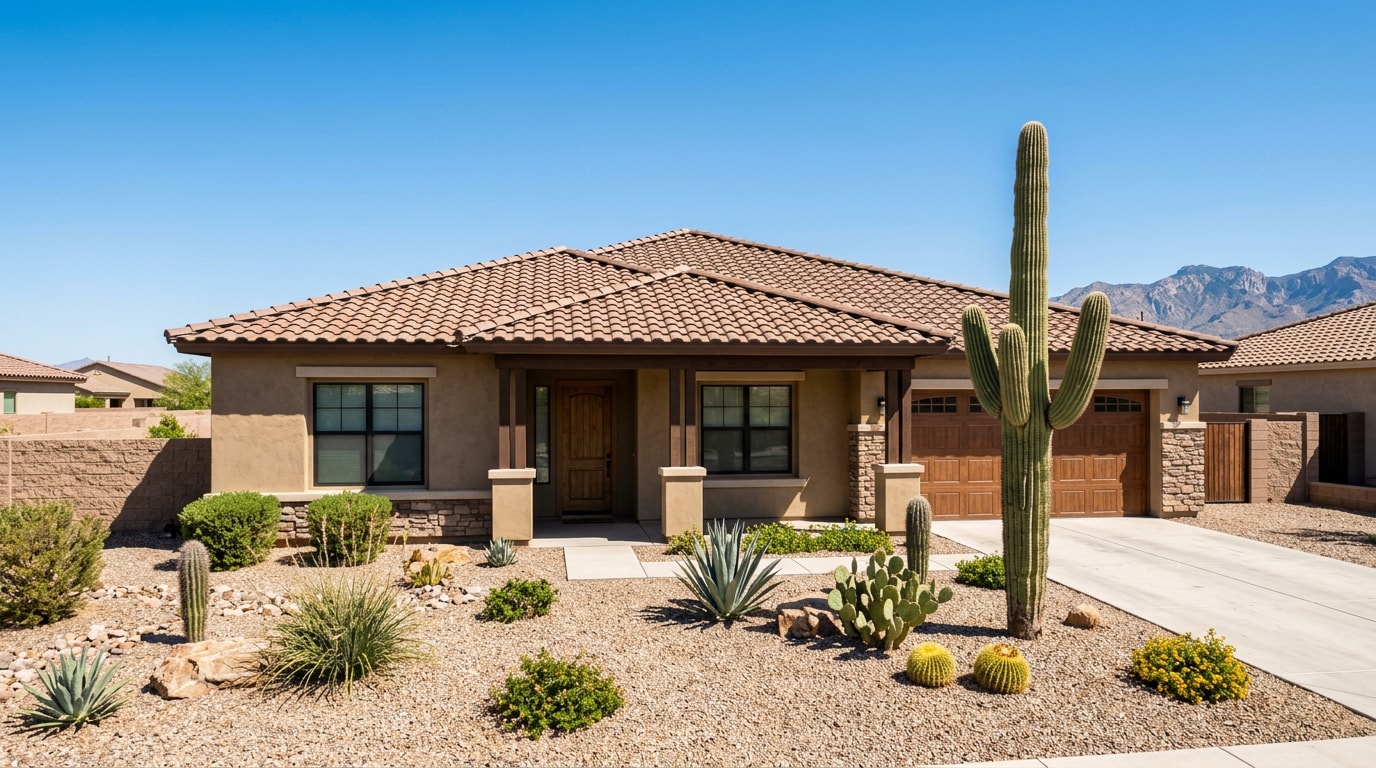
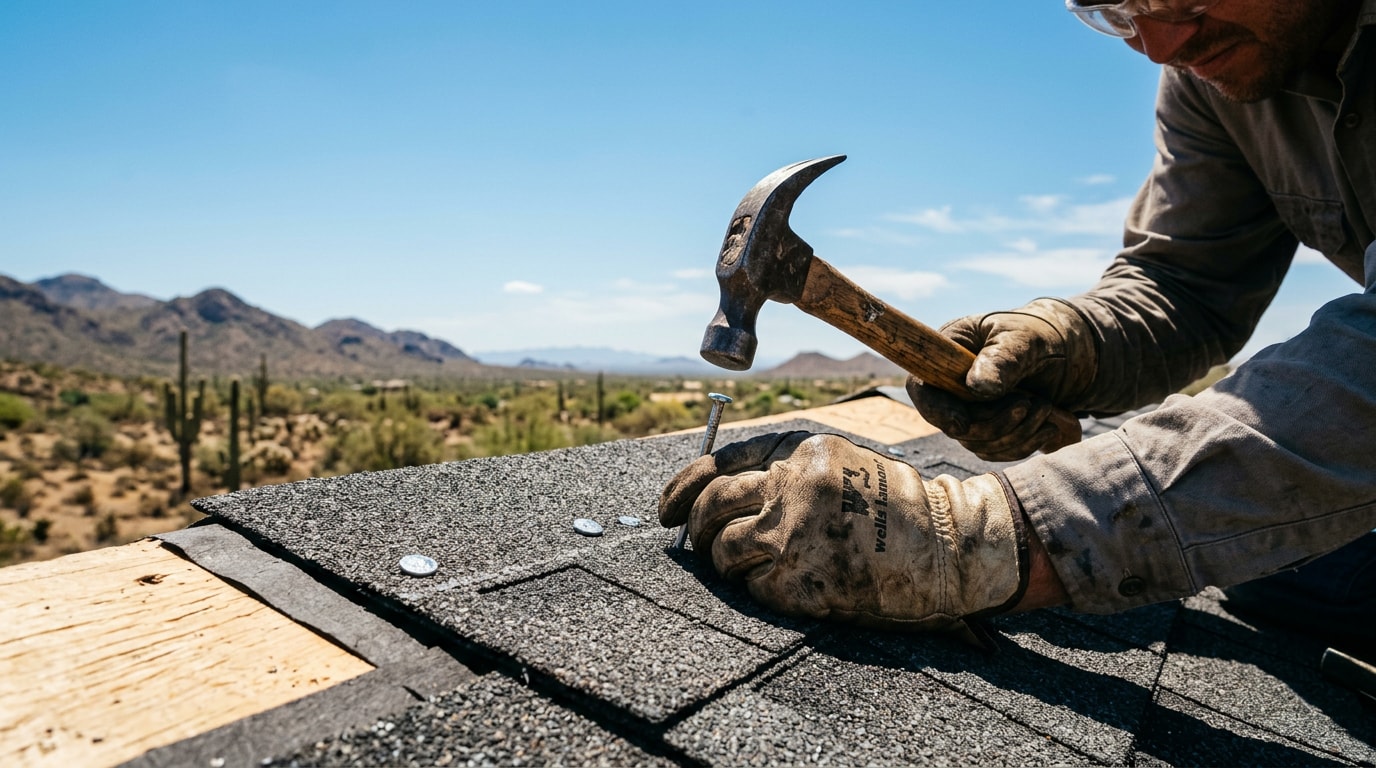
A roofing nail in Cave Creek, AZ has to survive conditions most fastener charts never account for: surface temperatures over 100°F, sustained high-UV exposure, and monsoon gusts that hit the roof deck every summer. The fastener holding your shingles down matters as much as the shingles themselves. This guide covers the roofing nail types, sizes, and materials that actually hold up in Cave Creek's desert climate, plus the code minimums any homeowner can use to check a contractor's work.
Visit Irish Roofing Company to see our services and request a free estimate.
What Size Roofing Nails Do You Need for Shingles?
For a standard single-layer asphalt shingle installation over 1/2-inch roof decking, the baseline answer is a 1-1/4 inch roofing nail. The right length depends on two variables: how thick your sheathing is, and what kind of job you're doing (new construction, overlay, or ridge cap).
A roofing nail needs to penetrate at least 3/4 inch into solid wood decking, or completely through sheathing thinner than 3/4 inch, to meet code and hold shingles securely under wind load. When sheathing is thinner than 3/4 inch, which is common with 1/2-inch plywood or OSB, the nail should pass all the way through and clinch rather than stopping short. Skipping this calculation is one of the most common reasons shingles lift during a windstorm even though they looked properly installed at first glance.
| Job Scenario | Recommended Nail Length | Why |
|---|---|---|
| New single-layer asphalt roof | 1-1/4 inch | Standard 1/2-inch decking, full 3/4-inch penetration |
| Re-roof or overlay | 1-1/2 inch | Compensates for the extra thickness of the old shingle layer |
| Ridge and hip cap | 1-3/4 to 2 inch | Cap shingles and ridge vent assemblies add depth |
| Thicker or double decking | Increase length accordingly | Maintains full 3/4-inch penetration past added sheathing |
Architectural shingles are often thicker than three-tab shingles, so checking the manufacturer's spec sheet before assuming a standard length is worth the extra minute.
Roofing Nail Types: Ring Shank vs. Smooth Shank
The shank is the single biggest factor in how well a nail resists pulling out. An annular, or ring, shank has raised ridges that mechanically lock into wood fibers as it's driven, while a smooth shank relies purely on friction to stay in place. Cap or square-cap nails exist mainly for securing underlayment and aren't a fit for shingle attachment itself.
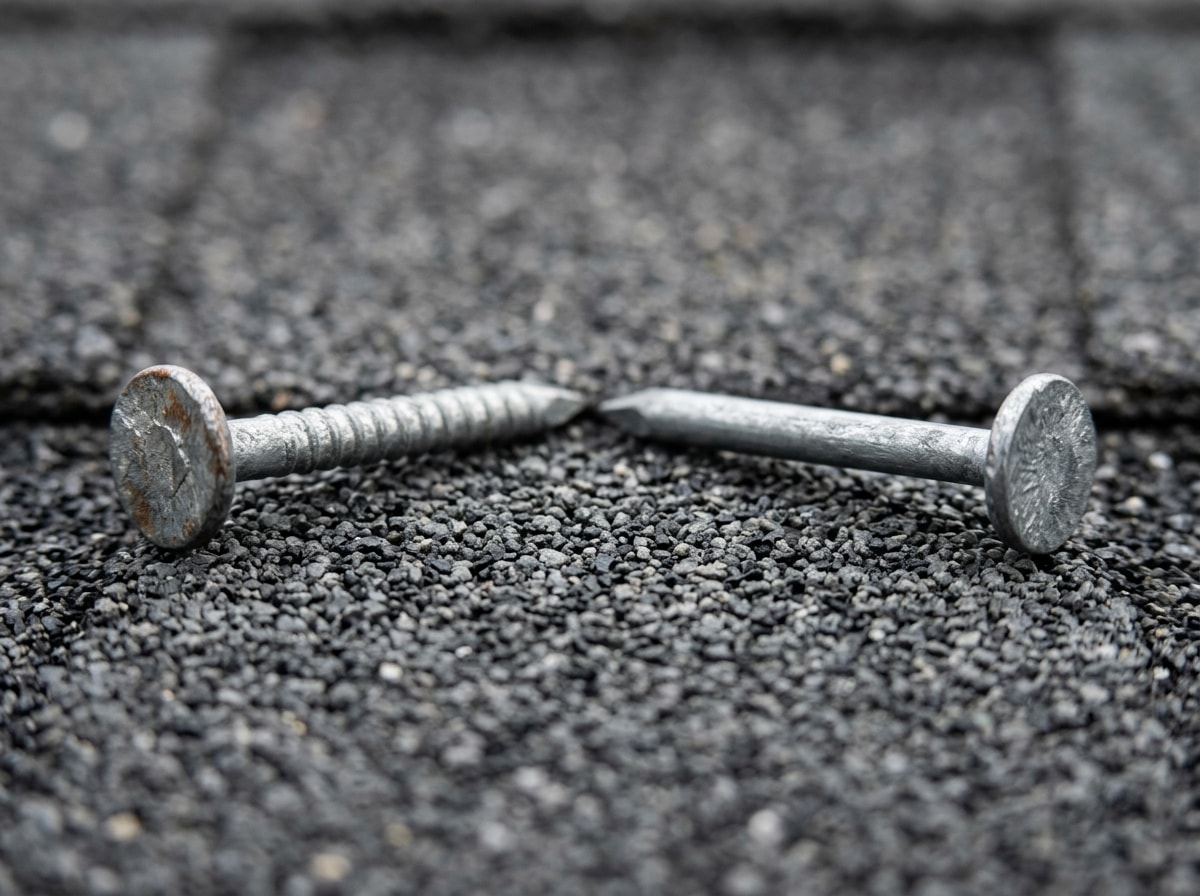
Smooth shank nails are generally adequate for standard, low-wind asphalt shingle jobs in a mild climate. Once wind speed, slope, or re-roofing enters the picture, ring shank or screw shank nails become the safer choice, since their mechanical grip resists the repeated uplift cycling that smooth shanks give up to over time. Steep slope roofing benefits too, since gravity constantly works against a smooth shank's weaker hold. For re-roofs over older decking that may already have fastener fatigue, the extra bite of a ring shank nail reduces the risk of future nail pops.
Roofing Nail Materials for Cave Creek's Desert Climate
Material determines how long a nail resists corrosion after installation. Hot-dip galvanized nails get a thick zinc coating applied by dipping, while electro-galvanized nails get a thinner, electroplated layer, a difference that matters more in practice than it sounds on paper. Stainless steel and copper nails cost more but offer the best corrosion resistance available.
| Material | Corrosion Resistance | Best Use in Cave Creek |
|---|---|---|
| Electro-galvanized | Lower (thin plated coating) | Budget interior framing only, not recommended for exposed shingle nailing |
| Hot-dip galvanized | Good (thick dipped zinc layer) | Standard recommendation for most asphalt shingle roofs |
| Stainless steel | Best available | High-value homes, steep-slope or long-service-life jobs |
| Aluminum | Good, naturally resists corrosion | Acceptable code option, less common in practice |
| Copper | Excellent, premium cost | Cedar shake and specialty installations |
On tear-offs across our Cave Creek service area, our crews regularly find that thinner electro-galvanized nail heads have already started rusting at the shingle surface well before the shingles themselves are due for replacement, a pattern we see less often with hot-dip galvanized fasteners on comparable roofs. Intense UV exposure and roof-surface heat accelerate coating breakdown faster here than in milder regions, which is why hot-dip galvanized is a safer default for Cave Creek than the thinner electro-galvanized option, and why stainless steel is worth the upgrade on steep-slope or high-value jobs. The material and dimensional standards for these fasteners are set out in ASTM F1667, the specification that governs roofing nail shank, head, and coating requirements referenced directly by building code.
Cave Creek Building Code Requirements for Roofing Nails
Building code sets a hard floor for roofing nails that no installation should fall below. Under IRC Section R905.2.5 and R905.2.6, asphalt shingle fasteners must be galvanized, stainless steel, aluminum, or copper roofing nails, at least 12-gauge, with a minimum 3/8-inch head diameter, long enough to penetrate at least 3/4 inch into the deck, with at least four fasteners per strip shingle.
These minimums give homeowners an objective way to check a quote or a completed roof rather than relying on a contractor's word. Manufacturer installation instructions are allowed to exceed these code minimums, and often do for wind-rated shingle lines, but they can never specify something weaker than what the code requires.
Cave Creek's own building department adds a locally specific layer worth knowing. The Town's re-roof inspection checklist sets a prescriptive minimum nailing pattern of 8d common nails at 6 inches on center at supported sheathing edges and 12 inches on center in the field, with the tighter edge spacing also applying at gable ends and diaphragm boundaries. That's a deck-attachment requirement separate from shingle nailing, but it's a detail a Cave Creek inspector will check during a re-roof, and it's worth asking any contractor whether their crew follows it before the shingles go down.
How Many Nails Per Shingle: 4-Nail vs. 6-Nail Patterns
Nail count is a wind-performance decision, not a place to cut corners. Standard asphalt shingle installations use a 4-nail pattern per shingle, but manufacturer wind-rating warranties and high-wind design conditions often require a 6-nail pattern instead. The Department of Energy's Building America Solution Center recommends six nails per shingle for high-wind locations, proper placement within the nailing zone, and driving nails neither over- nor under-flush as baseline practice for resilient asphalt roofs.
A homeowner can have an entire manufacturer warranty claim denied if an inspector finds only four nails per shingle where the product's installation instructions required six, an outcome insurers and manufacturers scrutinize closely after storm damage. Before assuming your roof meets its warranty terms, confirm which pattern your specific shingle product requires and ask your contractor to show it on a sample.
Drive Depth: The Compressor Setting That Saves Roofs
Even the correct nail fails if it's driven wrong. There are three outcomes when a nail gun fires into a shingle:
- Overdriven: the nail head cuts through the shingle mat and loses its grip.
- Underdriven: the head sits proud and can puncture the shingle layered above it.
- Properly driven: the head sits flush against the shingle surface without breaking it.
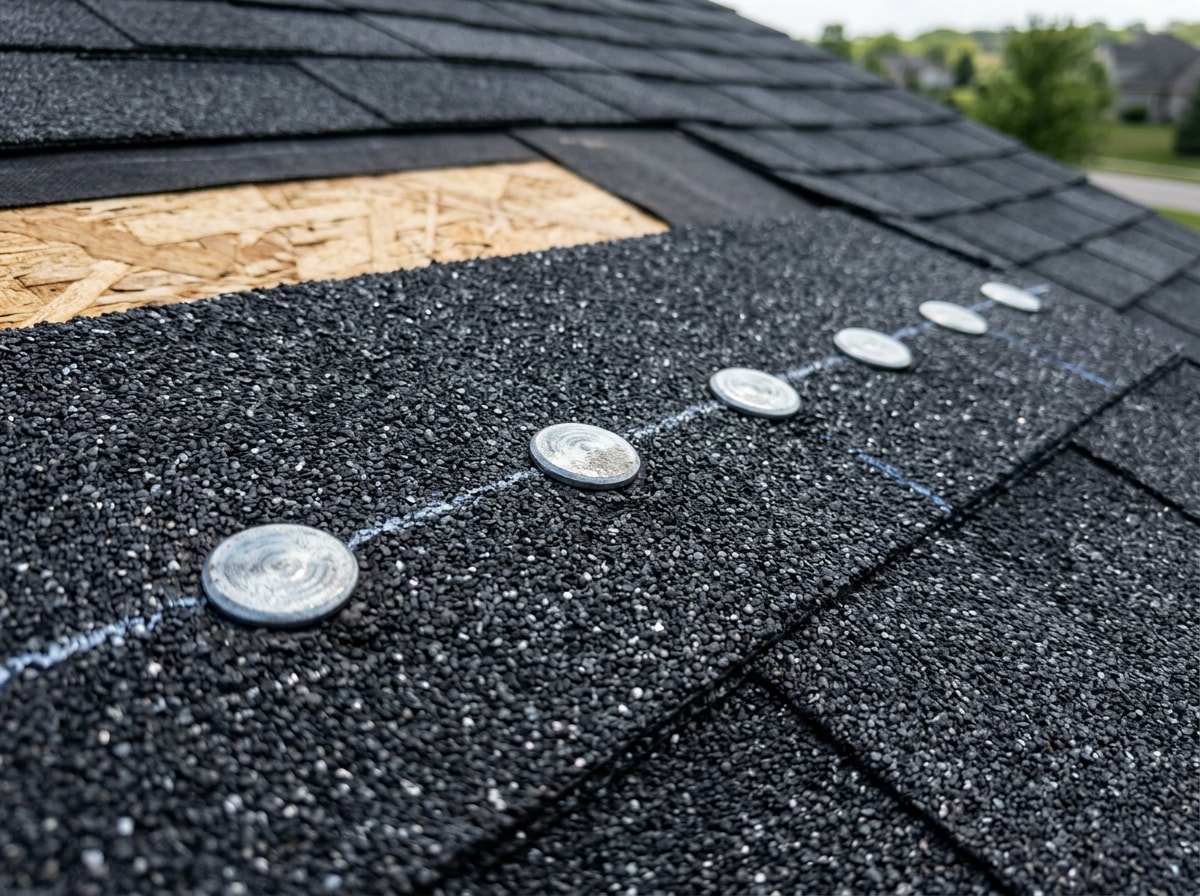
Overdriving usually comes from compressor pressure set too high for the shingle type, while underdriving typically means pressure set too low or a worn gun seal. Experienced roofers test and recalibrate a nail gun on a scrap piece of decking before starting a job, firing a few test nails and checking depth before touching the actual roof. Nail pops, small bumps visible under or through a shingle, are the symptom homeowners can spot later from the ground or attic, and they're often a sign this calibration step was skipped. If you're unsure whether your roof shows these signs, a roof inspection can confirm it before small problems become leaks. For a closer look at what a full moisture inspection in this area can catch early, see our guide on roofing leak repair in Cave Creek, AZ.
Matching Nails to Roofing Material
Different roofing materials call for distinct nail specs, not just different nail counts.
Asphalt Shingle Nailing
Asphalt shingles should be fastened with 1-1/4 to 1-1/2 inch nails, ring or screw shank, 11-12 gauge, with a 3/8-inch head. Hot-dip galvanized is the minimum recommended coating for Cave Creek, with stainless steel preferred for steep-slope or long-service-life jobs. Deviating from any single piece of this spec, shorter length, thinner gauge, or a lighter coating, reduces the nail's holding power and shortens its service life.
Wood Shake and Shingle Nailing
Wood shake roofs need longer nails than asphalt, typically because the shake material is thicker and calls for a different shank and material pairing. Hot-dip galvanized or stainless steel is standard here too, since wood shake sees more moisture cycling at the fastener point than asphalt. Cedar shake nails commonly run 1-3/4 to 2 inches depending on shake thickness, and smooth shank designs are sometimes used specifically so the shake can expand and contract with humidity without splitting around the nail.
Homeowners comparing roofing materials for a Cave Creek home, whether sticking with asphalt or looking at tile, metal, or other roofing contractor services, can see the full range of systems our crews install at {{SITE_URL}}/.
If you're planning a re-roof or replacement and want the fastener spec checked against code before work starts, our roof replacement team can walk through it during a free inspection.
FAQ
What size roofing nails do I need for asphalt shingles?
Use 1-1/4 inch roofing nails for a single layer of shingles over standard 1/2-inch decking. Use 1-1/2 inch nails for a re-roof over an existing layer, and 1-3/4 to 2 inch nails for ridge and hip caps. The nail must penetrate at least 3/4 inch into the deck or pass all the way through thinner sheathing.
How many nails per shingle does code require?
Code requires a minimum of four nails per shingle for standard installations. High-wind design conditions or manufacturer wind-rating warranties often push that requirement to six nails per shingle, so check your specific shingle's spec sheet before assuming your roof qualifies for full warranty coverage.
Can I use screws instead of nails for roofing shingles?
No. Screws are not an approved fastener for asphalt shingles under most manufacturer installation guidelines or building code, because their smaller head and rigid connection create a higher leak risk around the shingle's nailing zone than a properly driven roofing nail.
Can roofing nails be used for siding?
Generally no, except in specific manufacturer-approved cases such as certain fiber cement siding products installed to code. Roofing nails have a wider head and different length profile than siding nails, which can cause visible cratering or poor hold when used outside their intended application.
Nails vs. staples: which should you use?
Nails. Most current building codes and manufacturer warranties disfavor or outright prohibit staples for shingle installation, since staples have a narrower holding surface and a higher pull-through risk under wind load than a properly sized roofing nail.
Does Cave Creek check nailing during a re-roof inspection?
Yes. The Town of Cave Creek's building department inspects re-roofs against a published checklist that includes minimum nailing patterns for sheathing attachment in addition to the shingle fastener code minimums. Ask your contractor whether they've reviewed that checklist before the permit inspection.
Ready to have your roof's fasteners checked against code before your next Cave Creek re-roof? Schedule a free inspection with our team, or browse recent work on our projects page.